
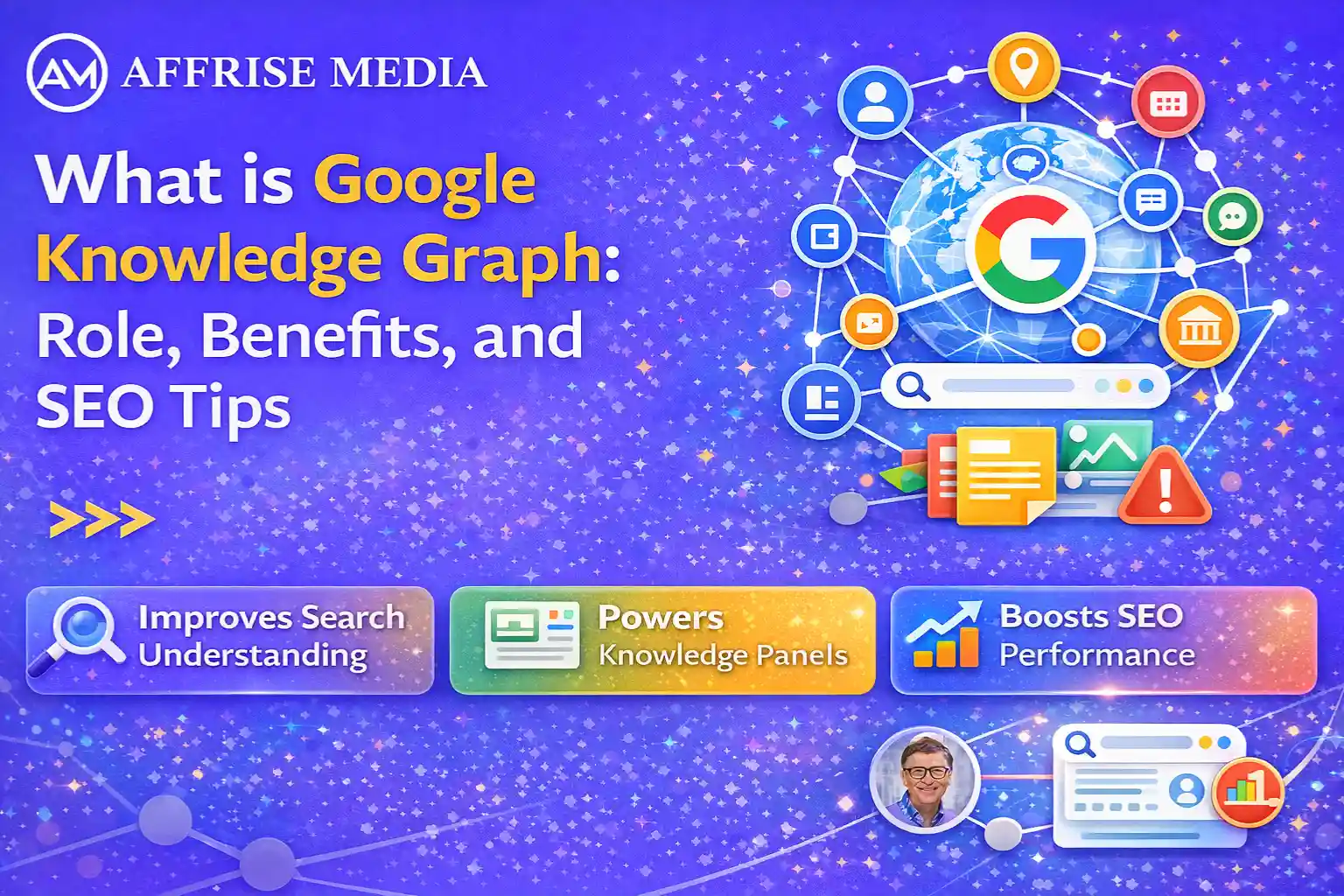
If you have ever searched for your favorite actor, a famous landmark, or a major brand, you must have noticed a neat, organized box of information on the right side of your search results. You didn’t have to click a single link to find out the age, location, or net worth. The answer was right there, in a little box.
That is the Google Knowledge Graph in action. In the early days of the internet, search engines were basically digital librarians that matched the exact words you typed to the words on a webpage. Today, search engines act more intelligently. They understand context, relationships, and intent.
For businesses and digital marketers, understanding how Google Knowledge Graph works is a critical part of modern SEO. In this blog, we are breaking down the meaning, role, and benefits of Google Knowledge Graph for your business, and how you can optimize for it.
What is the Google Knowledge Graph?
Google Knowledge Graph was first launched in 2012. Today, it has turned into a massive, interconnected database of information. It gathers data from a wide variety of high-authority sources across the internet, like Wikipedia, Wikidata, and licensed databases, to create a structural map of the world.
Instead of looking at search queries as just a string of letters, it looks at them as “entities.” An entity can be a person, a place, an organization, a movie, a historical event, or a concept.
Think of it as a giant digital brain. If you search for “Leonardo DiCaprio,” Google doesn’t just look for pages with his name. Because of its vast database of Google knowledge, it knows he is an entity (a human actor), it knows he starred in Titanic (another entity), and it knows he has worked closely with Martin Scorsese (yet another entity). The graph connects all these dots to provide a comprehensive snapshot of information.
Role of Google Knowledge Graph in Modern Search
The primary role of the Knowledge Graph is to transition search from “strings to things.” Its main objective is to provide users with immediate, highly accurate answers without requiring them to dig through multiple blue links.
When you look at modern search results, you can see its influence everywhere. It powers the rich snippets you see at the top of the page. It dictates the suggestions that pop up as you type. It is also the underlying engine that suggests related topics.
For example, when exploring a specific subject, you will frequently notice the People Also Search For section. This is entirely driven by the graph’s understanding of how different entities relate to one another.
Furthermore, this interconnected web of data is the backbone of voice search. When you ask Google Assistant or Siri a direct question, the Knowledge Graph is what allows the device to speak the correct answer back to you in seconds.
Benefits of Knowledge Graph for Businesses
Earning a spot in this powerful database can be a game-changer for your brand. Here is how businesses directly benefit:
1. Premium Search Visibility – The Knowledge Panel (the visual box that displays graph information) dominates the right side of desktop search results and takes up the entire first screen on mobile. Securing this spot gives you massive visual dominance over your competitors.
2. Instant Trust and Authority – Users inherently trust Google. When Google gives your business its own dedicated information panel, it acts as a digital badge of verification. It tells potential customers that your business is notable, established, and reputable.
3. Higher Quality Traffic – While some argue that instant answers steal clicks, the reality is that the Knowledge Graph filters out users who are just looking for quick information. The users who do click through to your website are generally highly qualified leads with a genuine intent to engage with your products or services.
SEO Tips on How to Get Included
A common question among business owners and SEO beginners is how to create Google Knowledge Graph presence for their own brands. The truth is, you cannot just fill out a form and instantly get a panel. Instead, you have to feed the search engine the right data so it connects the dots and builds it for you. Here are the most effective SEO tips to make that happen.
1. Implement Schema Markup (Structured Data)
The schema markup is a type of coding you place on your site to specifically inform Google of the type of content you have. By adding the schema markup of “Organization,” “Local Business,” or “Person,” you’re able to clearly define the name of your business, the logo, social media accounts, and contact information, making it incredibly easy for the graph to log in your information.
2. Optimize Your Google Business Profile
For local businesses, your Google Business Profile is the absolute most important step. Your business profile must be 100% complete with accurate business hours, high-quality images, and a consistent name, address, and phone number (NAP).
3. Build Authority on External Sites
Google draws heavily from established databases. Having a Wikipedia or Wikidata entry is one of the fastest ways to get a Knowledge Panel, but Wikipedia has strict notability guidelines. If you are not yet ready for Wikipedia, focus on getting featured in prominent industry publications, prominent news sources, and directories.
4. Maintain Consistency Across the Web
Next time you open your browser to Search google or Type a URL, remember that search algorithms value clarity. If your business is called “Smith & Co.” on your website, “Smith Company” on Facebook, and “Smith Co LLC” on Yelp, Google gets confused. Keep your entity information strictly consistent across the entire internet.
FAQs
A: It is a highly structured database used by Google to understand facts about people, places, things, and how they are connected. It allows the search engine to understand the context of your search rather than just matching keywords to web pages.
A: The primary role of the Knowledge Graph is to provide users with direct, instant, and accurate answers right on the search results page. It powers Knowledge Panels, rich snippets, autocomplete suggestions, and voice search responses by recognizing search queries as real-world entities.
A: Businesses benefit from Knowledge Graphs by gaining visual real estate on the search results page. Being featured in a Knowledge Panel establishes strong brand authority, builds immediate trust with potential customers, and helps capture highly targeted, high-intent website traffic.
A: To optimize for Google Knowledge Graphs, you should implement structured data on your website, have a fully updated Google Business Profile, maintain consistent business information across all internet directories, and build backlinks from high-authority sources like Wikidata or major news outlets.
A: You can ensure accurate information on the Knowledge Panel by clicking the “Claim this knowledge panel” option at the bottom of your brand’s panel in the search results. Once you verify your identity as the representative of the entity, you can use the “Suggest an edit” feature to correct factual errors, update logos, or change links.